| LIBROW | ® |
| Products | Solutions | Vehicles | Articles | Inquiry | Contacts | My account |
Digital instrument cluster
VIC Laplace Z
Category. Virtual interface electronics.
Application. Automotive.
Description. Wide virtual instrument cluster for 12 V systems.
 |
Download VIC Laplace Z specification (pdf, 0.4 MB) |
|
Download VIC Laplace Z specification — printer friendly (pdf, 0.2 MB) |
1. Introduction
VIC in the name of the cluster stands for virtual instrument cluster — in a nutshell this device is a high-performance embedded graphics processor. From its startup to shutdown the performance is a primary concern for this unit. Flash with high access rate, wide memory access busses, highest available frequencies — all the aspects are taken to their extremes for excellence in driving experience.
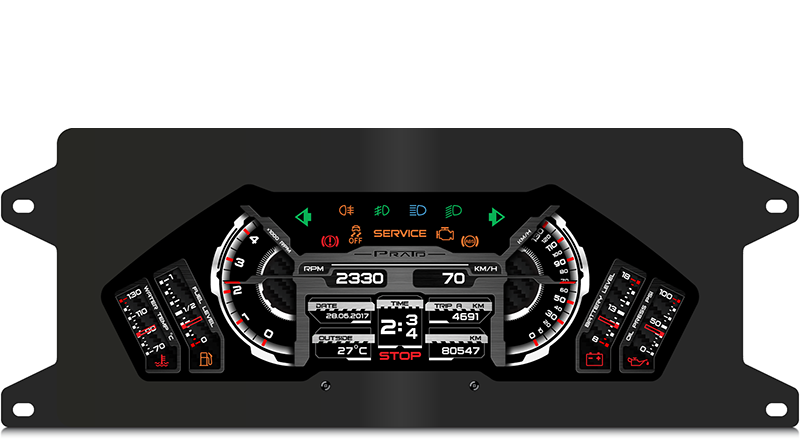
 Fig. 1. VIC Laplace Z — digital LCD panel for a supercar. Graphical design — Bruno Prata.
As result of the performance optimization the cluster starts up in a fraction of a second and renders 60 freshly built frames per second. Precision graphics algorithms are catching differences of a fraction of a pixel and delivering a new frame in 1/60 of a second to provide smoothest possible animation.
Despite its impressive performance the device stays cold even at peak load due to “cold design” — a set of special solutions used for every stage of the cluster hardware. These solutions ensure every part of the instrument cluster uses minimum power for its operation.
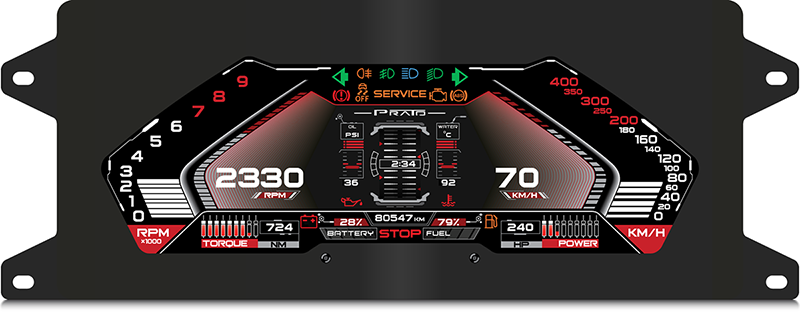 Fig. 2. VIC Laplace Z in race mode. Graphical design — Bruno Prata.
Originally Laplace Z was developed as a digital LCD dashboard for Prato Orage supercar. In Prato Orage it renders two modes: sport and race — see fig. 1 and fig. 2.
2. Display
The cluster is equipped with rugged, high-brightness and high-contrast LCD — liquid-crystal display — of 1280×480 resolution. The aspect ratio of the display is 8:3 — wide format.
| Display data | |
|---|---|
| View area size | 293.76 mm×110.16 mm |
| Resolution | 1280×480 |
| Aspect ratio | 8:3 |
| Color resolution | 18 bit |
| Brightness | 1000 cd/m2 |
| Contrast ratio | 800 |
| Refresh rate | 60 Hz |
| Operating temperature | −30°C…+80°C |
The display has square pixels of 0.23 mm size. Naked eye average angular resolution is 1′ — which means, that approximately from distance of 80 cm the pixels are getting indiscernible.
Display refresh rate is 60 Hz — that is every second the displayed image is updated 60 times.
3. Sound
The cluster has two sound sources on-board. First one is a high-pressure — 85 dB/10 cm — sounder, which produces alert chimes. Second sound source is a relay, which makes audible turn and hazard clicks.
4. Hardware
The heart of the digital cluster is a SoC — system on chip — with Arm core at 400 MHz. The SoC has an embedded graphics engine capable of 2D and 3D scene building.
Due to its performance graphics engine can render 60 mixed 2D and 3D scenes per second. That guarantees every displayed frame is freshly built, which leads to the smoothest possible animation.
| Hardware data | |
|---|---|
| Processor architecture | Arm at 400 MHz |
| Graphics engine | 2D and 3D |
| Frame rate | 60 Hz |
| Flash memory | 64 MB |
| DDR memory | 128 MB |
| MRAM memory | 256 kB |
| Operating temperature | −40°C…+85°C |
The cluster has three types of memory on-board: flash, DDR and MRAM. Flash is a memory which keeps the processing code and graphics in off state. DDR is a dynamic memory with fast access — here processor makes calculations and builds frames for display. MRAM is a magnetoresistive memory — like flash it can keep data in off state, but has unlimited number of rewrite cycles, while flash has a limit. MRAM is a convenient storage for dynamic data which should be kept in off state — like settings, trip counters and odometer.
Image of 1280×480 space resolution and 16 bit color resolution occupies 1.2 MB of memory. In terms of full-screen images flash can keep more than 50 and DDR more than 100 scenes — more than enough for the most demanding graphics.
5. Housing
The cluster has black hard-anodized housing milled of avionic aluminum. There are several advantages in metal housing.
Aluminum housing advantages
|
The cluster housing is milled from an aluminum block with ±0.1 mm precision. The precision provides excellent surface planarity, which guarantees no stress is maintained inside high-frequency printed circuit board in the assembled state.
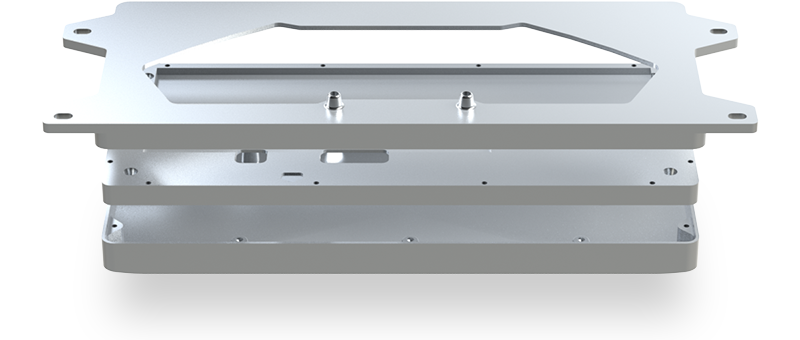 Fig. 3. VIC Laplace Z has a precision aluminum housing.
As well aluminum housing serves as a rigid frame both for display and printed circuit board — high frequency board is sensitive to deformation, especially twists and bends — and rigid hosing protects it from mechanical stress.
EME stands for electromagnetic emission. The point is at high frequencies every signal conductor gets an emitting antenna. That is why it is a good practice to encase computers into metal housing. In our case aluminum housing makes the cluster as radio silent as possible.
On the other hand metal housing prevents radio waves not only from getting out but as well from getting in. So, the aluminum housing increases EMI — electromagnetic interference — immunity.
Unlike plastic aluminum alloy can be easily recycled — just melt it to create new thing. It is true that aluminum is more energy consuming at production stage than steel, but at recycle stage aluminum is less energy consuming than steel due to its low melting temperature.
6. Dimensions
The instrument cluster is mounted with four M6 screws. Slotted holes allow adjustment ±2 mm in horizontal direction.
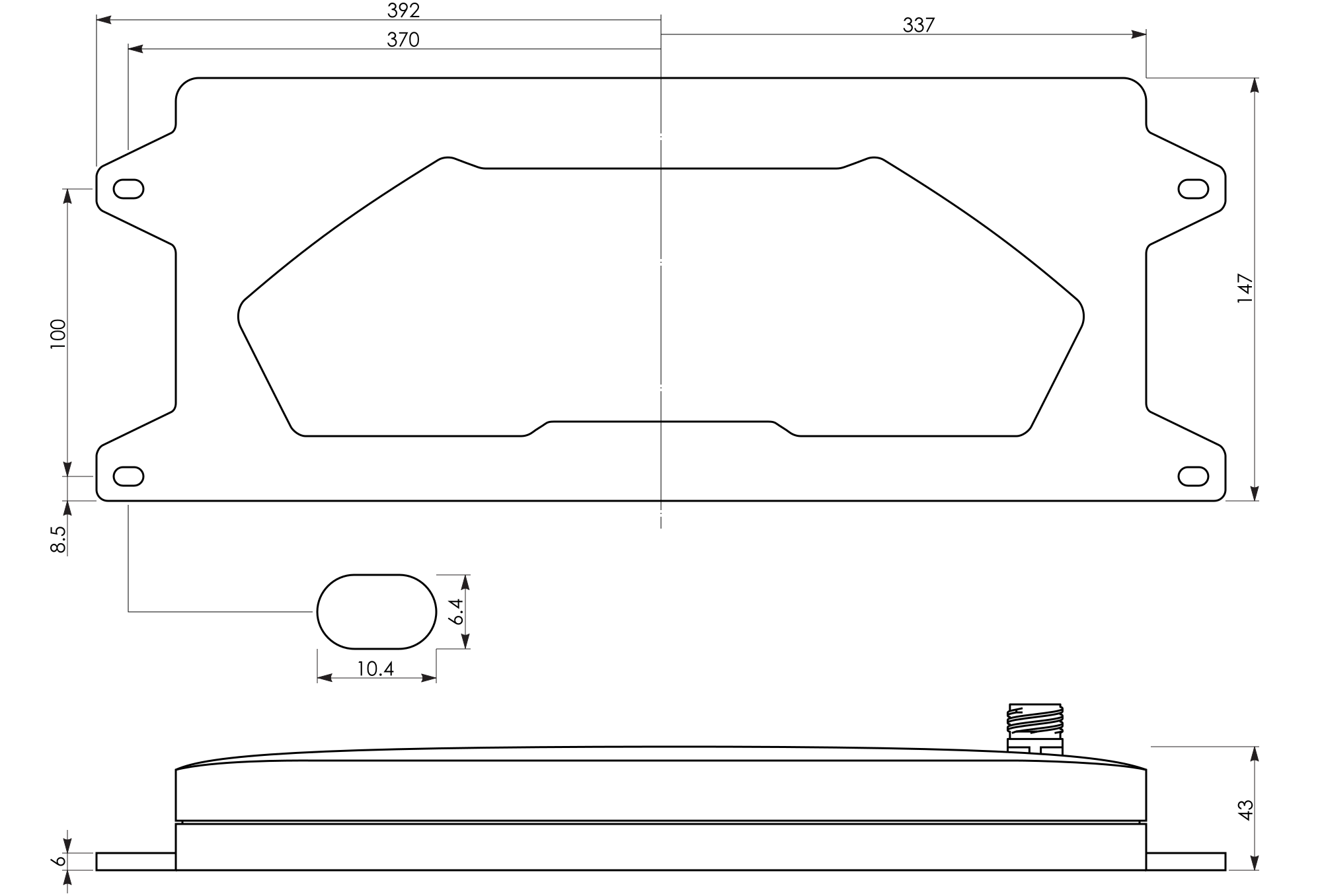 Fig. 4. VIC Laplace Z dimensions.
7. Interface
Cluster interface is purely digital — it includes two CAN busses and Enable line.
| Interface | |
|---|---|
| CAN1 | Up to 1 Mb/s |
| CAN2 | Up to 1 Mb/s |
| Enable | 4 V–80 V |
CAN stands for controller area network — automotive data bus built on principles similar to Ethernet, where signal is passed on a twisted pair. That is why every bus consists of a signal pair CAN+ and CAN−. Two buses could be used as data bus and control bus — on data bus cluster gets real-time status data for display and on control bus it gets commands for changing the display mode, brightness adjustment, trip counter reset, etc.
Enable line is used to switch on and off the cluster. The cluster has hold function implemented and it switches off not immediately but after performing house-keeping functions — like storing temporary data, dimming the display and switching off its backlight. In other words it switches off gracefully.
8. Connector
The cluster features aerospace subminiature connector of Tri-Start series — the same connectors are used in aircraft and artificial satellites. Tri-Start are heavy duty sealed connectors with gold plated contacts.
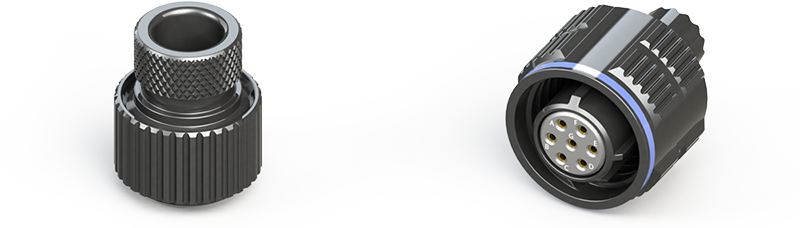 Fig. 5. VIC Laplace Z aerospace plug and its backshell.
The connector has B99 shell with 7 pins of AWG 20 size.
| Pin | Function |
|---|---|
| A | CAN2− |
| B | CAN2+ |
| C | Enable |
| D | Power +12 V |
| E | CAN1+ |
| F | CAN1− |
| G | Power −12 V |
9. Power and protection
Due to the robust power stage the digital cluster Laplace Z can work from a power source of 6 V–80 V. But in automotive environment there are extra issues to be taken into account. The point is automotive power is not ideal: battery plus and minus could be swapped, for engine startup another battery could be connected in series with the on-board one, another devices can cause voltage spikes and there could happen most dangerous event — power dump.
Plus and minus swap is the simplest thing could happen — in this case every device powered gets into state which is called reverse battery.
Condition, when another battery connected in series with the on-board one is called double battery — in this case every powered device gets 24 V instead of nominal 12 V. Similar condition emerges when the battery is overcharged — it is not that severe as double battery, but devices are anyway powered with much higher voltage than nominal.
Spikes caused by other devices are called transients — usually it is a consequence of different loads switching, like motor starting and stopping or solenoid activation and deactivation. Though these spikes could have high voltage, their power is quite low and transients could be effectively filtered out.
 Fig. 6. Voltage transients.
But there is a transient, which cannot not be filtered out, because of its high energy — and that is why it is so dangerous. This powerful spike is called power dump. It happens, when the battery charged by the alternator gets disconnected. Charging current could be very high because the battery has very low resistance, and when it gets disconnected, alternator windings, being just big coils, are still pushing that amount of current into the power network. Since the power network cannot absorb that amount of current, voltage goes through the roof. Basically the power network gets an intense current shock.
The digital instrument cluster Laplace Z has protection against everything from above. Against reverse battery it is protected by ideal diode — it is a smart solution, which does not dissipate power. Against double battery it is protected by special design of the power stage — at higher voltage cluster intakes less current still consuming the same power from the battery. Against transients it is protected by input filters. And for power dump it has on-board a surge stopper, which limits the input voltage.
| Power | |
|---|---|
| Nominal power | 12 V |
| Operating range | 6 V–80 V |
| Reverse battery protection | yes |
| Double battery protection | yes |
| Power transient protection | IV level of ISO 7673-2 |
| Power dump protection | IV level of ISO 16750-2 |
There are standards ISO 7637-2 and ISO 16750-2, which specify automotive device power protection — according to these standards the digital cluster Laplace Z has the highest IV level of protection.
10. Options
This product comes with a number of options to customize its appearance and behavior.
VIC Laplace Z options
|
Here is a sample how options from above work in practice. Let us say, you have a list of parameters to display, maybe with hints how that should behave and look, or maybe your design is already drawn and just waits for its implementation. In any case we will bring it to the point it is ready for embedded real-time graphics.
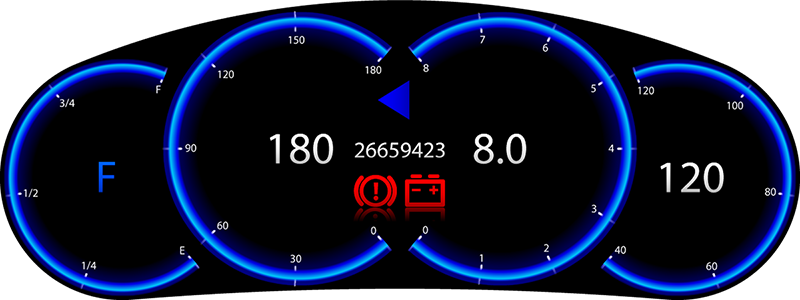 Fig. 7. VIC Laplace Z custom graphics.
Next point is housing. Every vehicle is different and has its own aesthetical and mechanical requirements. So, we modify housing shape, color and mounting accordingly for easy integration into the vehicle interior.
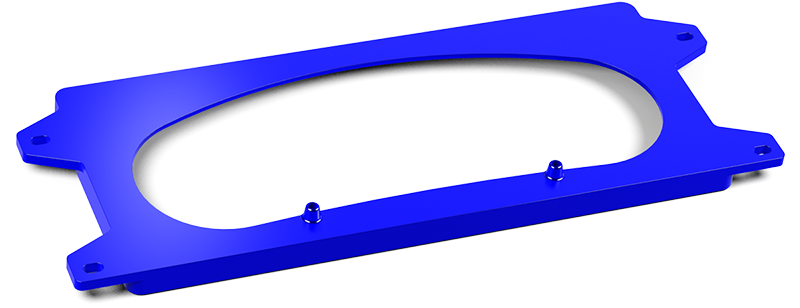 Fig. 8. VIC Laplace Z custom face.
Maybe you are wondering what those two protrusions on the housing face are. They are holders for ambient light sensors. Two sensors provide stereo ambient light sensing for display brightness adjustment, so that in different lighting conditions display looks the same. This feature is optional — if removed cluster will rely on data provided by HVAC ambient light sensor or just on brightness settings.
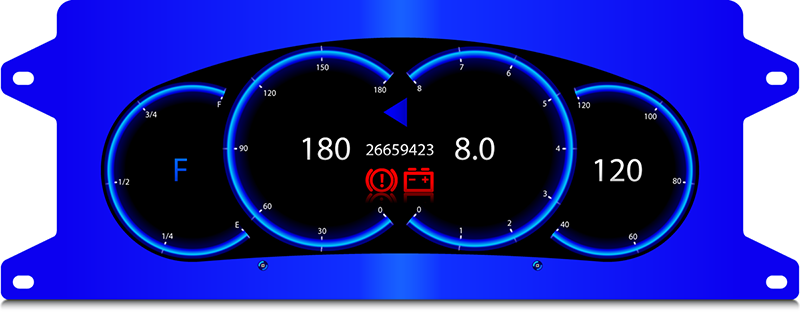 Fig. 9. Custom digital instrument cluster Laplace Z.
11. Sell offer
The offer includes both custom design and custom programming.
Included
|
We will equip your project with custom version of VIC Laplace Z at these prices in euro.
| Quantity | Each item | Mating connector | Each item with mating connector |
|---|---|---|---|
| 1 | 8649 | 89 | 8699 |
| 4 | 3939 | 3989 | |
| 10 | 3539 | 3589 | |
| 20 | 3209 | 3259 | |
| 50 | 2739 | 2789 | |
| 100 | 2359 | 2409 |
Mating connector consists of two parts — plug and its backshell. The backshell is executed as a shrink boot adapter.
Next
|


| Digital instrument cluster VIC Laplace Z |
|
| Digital instrument cluster VIC Lomonosov Z |
|
|||||||||||||
 |
|||||||||||||
|
|||||||||||||
